Presented by HP Rivers
Westside Unitarian Universalist Church
Sunday, April 14, 2024
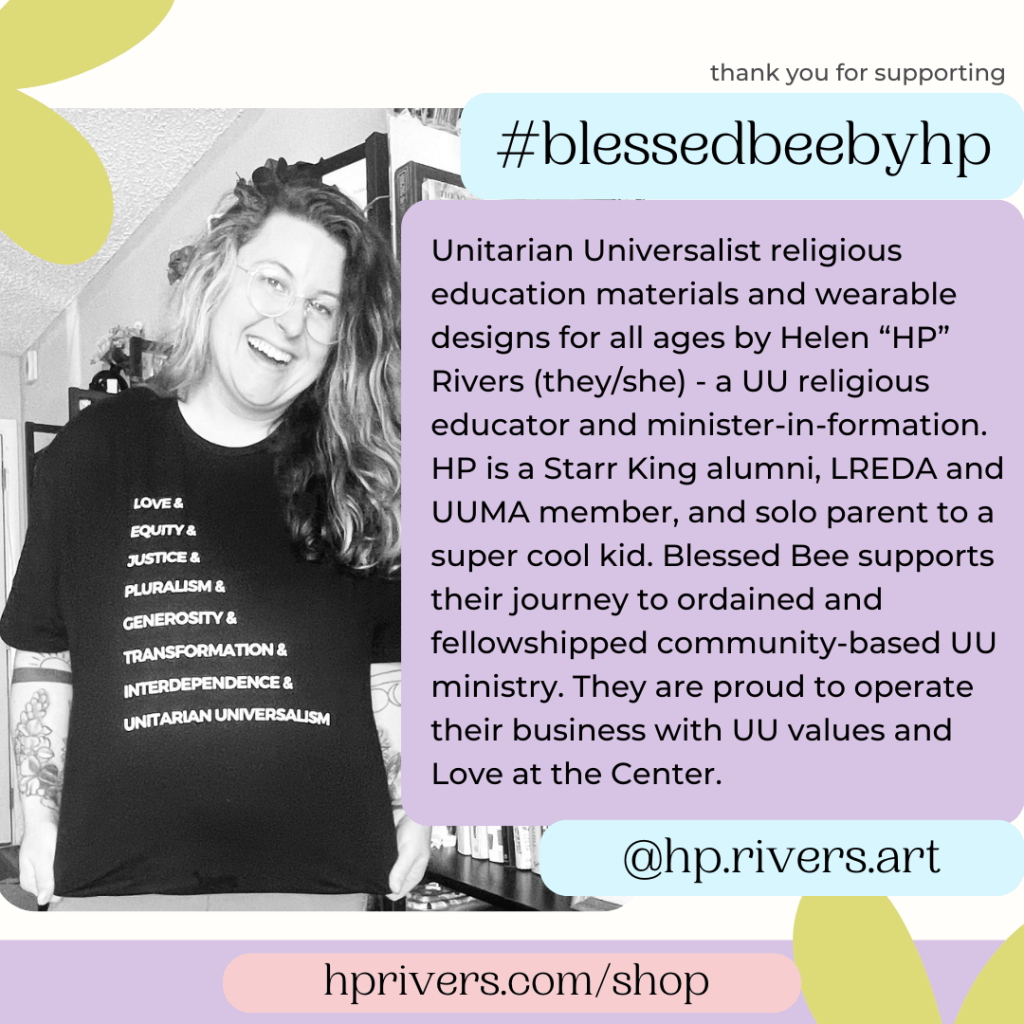
If I haven’t gotten a chance to meet you yet, my name is Helen. My pronouns are they/them/theirs and I am a Unitarian Universalist religious professional and minister in formation, or, as I like to say, pastor in progress. I’m a solo parent to 8-year-old Henry and two cats, Rumi and Danny Danger, and my hobbies include writing, photography, and baking.
I’ve been a member of Westside since 2011 and began the process of becoming a Unitarian Universalist minister in 2018. I moved to Florida in 2019 in pursuit of that goal, where I served the UU Church of Tallahassee as Director of Religious Education for four years as I attended seminary. I earned my Masters degree from a Unitarian Universalist identity seminary, Starr King School for the Ministry, in 2023, and my degree is in Religious Leadership for Social Change with a focus on religious education.
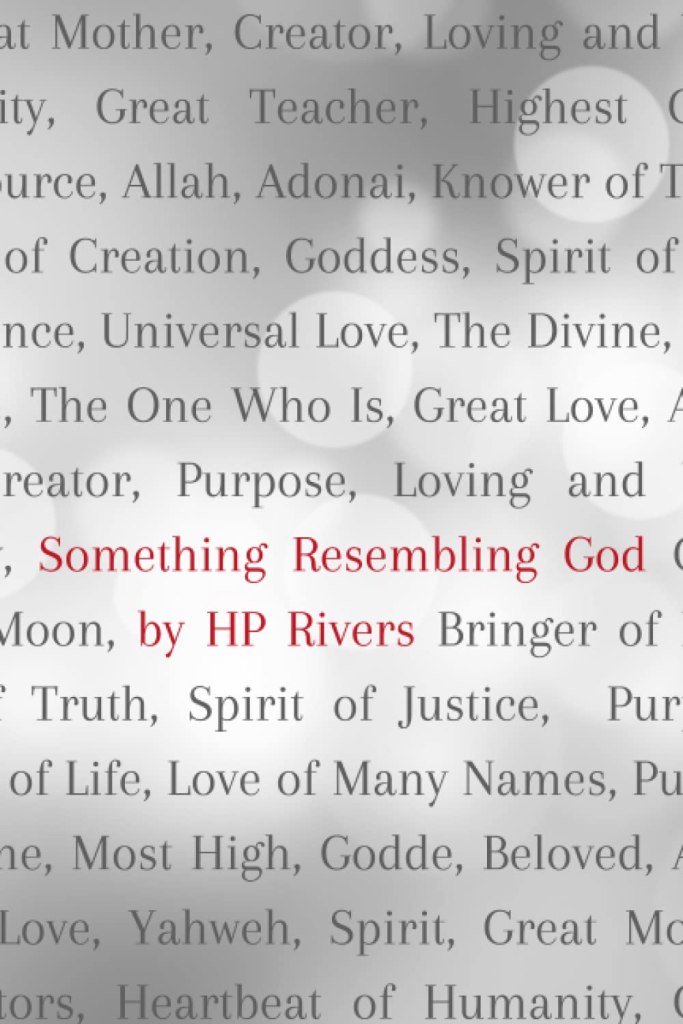
For my thesis project, I wrote a small group ministry curriculum about trauma and trauma response entitled Anagape Trauma and the Beloved Community, which I hope to turn into a book one day. Currently, I am working…. A lot. I serve a UU Church as a media specialist, doing all of their social media and communications. I’m doing some curriculum writing writing and sensitivity reading, and I’m editing an upcoming anti-racism curriculum. I also do some freelance photography and social media consulting on the side. I published my first book of poetry, Something Resembling God, last year and will have a sermon about my coming out experience featured in an upcoming anthology of essays from queer Unitarian Universalists.
I was quite pleased, and surprised, recently to learn that a poem I wrote entitled Blessed Are the Queer has become considered UU and queer liturgy. I did the thing you’re never supposed to do – Google yourself – and found this poem has transcended denominations and has been used in countless Pride services over the last few years. I realized it was bigger than me last year at an interfaith Pride service, where I was in attendance. The organizers didn’t know “HP Rivers,” my pen name, was a local or would be there, and I had the strange honor of watching a crowd of worshippers react to my words. It was a holy moment for me. I have wanted to be a writer since I wrote my first poem at eight years old, and it feels bizarre and beautiful that I’ve finally arrived as I prepare to slide into thirty-one next weekend.
I’ve spent the last five years away from Knoxville working in faith communities, attending seminary, and learning way more than I expected about answering a call to serve God and Her people.
As a UU and lifelong skeptic, I never expected I’d proclaim a belief in God, and for a long time, I was one of the ones who cringed at the concept. Even when I was a newbie in AA once upon a time, the whole idea of a higher power felt like an attack on my intelligence as well as my agency. (Two things I’ve noticed UUs really can’t stand.)
To be clear, I don’t expect anyone else to share my perspective- this is my take on God, not UU’s take on God. But I’ve found for myself a deep belief, and a deep comfort, in surrendering to the idea of God as a Love energy from which all things originate and to which all things eventually return. I think that Source probably transcends our ability to understand, that’s probably part of the point, and human experiences exist on a spectrum of love to distance from love, or God to distance from God. I know the God of my understanding isn’t always the same as others’, but often we can connect over the core concept of a benevolent higher power. The difference for me is I don’t believe we are something separate from God – I believe we are all unique representations of the Divine, and we all deserve to exist accordingly.
That’s all well and good until we actually have to exist in the world together, until your inherent worth and dignity bumps up against my inherent worth and dignity and we are tasked with coexisting in a vacuum of capitalism and binary thinking.
It’s a rough world out there. It’s hard to look at my newsfeed some days, just knowing I can never truly be prepared for the Next Thing. Just when I think it can’t get harder, it does. Just when I think it can’t get more gruesome, it does. Just when I decide to look away, the little voice in the back of my head says, “Don’t do it. You’re so privileged. The least you can do is witness.” And then eventually my mental health takes a nosedive from witnessing atrocity after atrocity, interspersed with ads for weight loss drugs and photos of my friends’ pets.
It feels hopeless sometimes, to hold space for the Divinity of all beings while my heart is breaking for the suffering of the world. It feels Too Big and Too Hard to really feel and witness the enormity of the world’s grief.
What do we do with the enormous grief that exists in the world, especially when it often exists simultaneously with enormous joy and enormous disparity?
What do we do about a hurting world and broken systems, all of which are so much bigger than any one person or community?
I mentioned earlier that there was an ingredient missing from our recipe for a UU minister. Does anyone want to take a guess at what it might be?
I’d say that the last ingredient that is super necessary to make a UU minister, and to do something with our hurting world and broken systems is the same thing – Beloved Community.
If you’re not familiar, the Beloved Community is a concept that was popularized by the Rev. Dr. Martin Luther King Jr. I can’t explain it any better than the King Center already has, so the following is an excerpt from their website:
Dr. King’s Beloved Community is a global vision, in which all people can share in the wealth of the earth. In the Beloved Community, poverty, hunger and homelessness will not be tolerated because international standards of human decency will not allow it. Racism and all forms of discrimination, bigotry and prejudice will be replaced by an all-inclusive spirit of sisterhood and brotherhood. In the Beloved Community, international disputes will be resolved by peaceful conflict-resolution and reconciliation of adversaries, instead of military power. Love and trust will triumph over fear and hatred. Peace with justice will prevail over war and military conflict.
Dr. King’s Beloved Community was not devoid of interpersonal, group or international conflict. Instead he recognized that conflict was an inevitable part of human experience. But he believed that conflicts could be resolved peacefully and adversaries could be reconciled through a mutual, determined commitment to nonviolence. No conflict, he believed, need erupt in violence. And all conflicts in The Beloved Community should end with reconciliation of adversaries cooperating together in a spirit of friendship and goodwill.
Now THAT is a tall order. It might even sound like a pipe dream, or like some idealistic woke nonsense that hippie white girls with healing crystals stuffed in their bras would post on Instagram.
I’m not saying it’s easy, but I am saying it’s possible – and I am living proof.
Going through this process as a: first-generation college student and as a neurodivergent solo parent of a neurodivergent child has often felt like playing life on hard mode, and that was before the pandemic. I mentioned earlier that I am at a point in my career where I still have a ways to go, but I’m starting to feel as if I’ve accomplished some important goals.
What I didn’t mention is that it is a bonafide miracle that I am still upright, and that I wouldn’t be without my Beloved Community.
I’m not sure I ever would have realized and believed that I am Enough to be a minister if my minister hadn’t steadfastly and insistently affirmed that I am.
I never would have written my first sermon if a fellow Westsider hadn’t read my blog and casually suggested that I should give a sermon at Westside sometime.
If I’d never written that sermon, I wouldn’t have shown it to a local UU community minister. He wouldn’t have said, “Wow, you can preach!” and I wouldn’t have left that coffee shop determined to apply to seminary.
If I’d never applied to seminary, I never would have met one of my dearest friends, whose presence in my life is a gift and a balm. I never would have made it through seminary without her, and she never misses a chance to speak my name in rooms full of opportunities.
One of those opportunities helped offer me the stability to move home, which I also couldn’t have done without my best friend and his husband, who waited over a year for me to be ready to leave my unhealthy marriage and came running to help me pack and move when it was finally time.
When it was time, I couldn’t have afforded the lawyer who helped me navigate the divorce and ensure an equitable settlement without my colleagues in TRUUsT, Transgender Religious Professional Unitarian Universalists Together, who helped me raise the funds through a mutual aid campaign that was supported by my friends, colleagues, and even a few of y’all here at Westside.
And none of that, none of this, would have happened if Westside hadn’t been here to welcome me with open arms when I needed a soft place to land. This soft place to land became an anchor as I navigated some of the hardest years of my life, and a safe place to grow into a more authentic version of myself. And when I was ready, this community was a safe thing to say goodbye to, because I knew they would always be here, so I would always have a safe place to land… or cry.. Or study.. Or say something brave. Or park my moving truck for a week.. Y’all get the picture.
My bio on the UUA website says I was “raised on love and coffee by Westside UU Church in Knoxville, Tennessee” because it is true – this community has raised me in every way that counts, and I wouldn’t have achieved half my current success or well-being without you.
This community, and so many other UU communities, already know how to embody the Beloved Community, even when we do it imperfectly, even if we’ve broken our vows a thousand times and we have to do the hard thing and work to remain in relationship with one another when it might seem so much easier to turn away. That’s how I know that Rev. Dr. King’s vision is not a pipe dream – it is entirely possible and already exists – if you know where to seek it.
So what’s next for me in this journey?
I’m not entirely sure yet. I wish this call came with instructions, or maybe a map.
I wish I could get up here and say,
“Hey y’all, God called, She told me exactly what to do and wrote it down so I won’t forget and broke it down into little steps because that’s how my brain works best.
She also got me a snack, gave me a forehead kiss, took care of those genocides that have been clogging up our newsfeeds, and fixed the environment. Here’s the plan.”
Listen, sometimes the call is loud and sometimes it is blunt – I would be disloyal to my call if I stood at a sacred desk and did not even mention that over 40,000 of our siblings in Palestine have been murdered by colonial forces in the last six months, and the fog of propaganda, misinformation, black and white thinking, and fear of saying the wrong thing surrounding the situation has left too many of us silent. I’d like to remind us that our primary symbol, the flaming chalice, was once a signal of safety to people escaping genocide – and perhaps we are the ones we’ve been waiting for.
This world reveals new extremes of beauty and brutality every day, and something greater than myself is calling me to serve and witness the sacred in all of it.
Trust me, I wish I could have been a kindergarten teacher, or a stand-up comedian. But apparently that’s how you know it’s a call – when it’s not necessarily what you want to do, but what you simply know you must do – even if you low-key hate it sometimes.
I’ve occasionally found myself feeling jealous of people of faith with straightforward dogma to adhere to and ministers in denominations that don’t have such a rigorous credentialing process. But those places are, largely, also where my identities would preclude me from serving as clergy, where my unique manifestation of that great Love would not be celebrated as it is here, but rather condemned.
While I admit that I’ve threatened to quit the entire MFC process at least a few dozen times now, and there needs to be a lot of conversation about the ableism, classism, and white supremacy culture embedded in the process, I know there is no faith I would rather serve and grow with than Unitarian Universalism.
I also know my call comes from something that transcends any labels we could give it or ourselves – at the end of the day, we are all Beloved Children of the Universe experiencing this strange and beautiful journey together. I am so thankful that out of all the faiths and all the faith communities out there, I get to call this one mine.
Some of you have asked me if I will be completing an internship at Westside or otherwise working here and the answer is oh hell no.
I have accepted that as a UU religious professional, I’m always kind of on-duty in UU spaces. I also know that there’s this thing that happens once you commit to becoming a minister and begin to embody that role – people start treating you like a minister. That’s why I drop strategic swear words in so people know I’m not that kind of minister and why the woman who cut my hair last weekend asked me to pray for her son. I did, of course, and I don’t think it matters much, if at all, that the God of my understanding is obviously different from hers.
This phenomenon of being treated like a minister is also why ever since I moved home, coming to church has felt a little bit like going to work. And that’s ok, that’s something I signed up for.
Westside has an important role to play in my ongoing formation, but it isn’t as an employer. Westside’s role is to be what you have always been – a safe place to land. Now what exactly does that look like? Again, I’m not entirely sure, but that doesn’t worry me.
I’ve worked with kids for about 16 years now, and one of my favorite things is when a kid asks me a question that I don’t know the answer to. That way, we get to figure it out together, and we both get to learn something new. As UUs, we never stop learning, and that is one of my favorite things about us and our Living Tradition. This is new and different for us, like so many things are right now, and I’m sure we’re going to get it wrong sometimes as we learn together –
but I’m just as sure that we’re also going to work together to get it right.
I am in the process of working out an internship with another congregation, and I hope to have some updates for you in the next month or so about that. For today, I’ve made some treats to share for coffee hour (they’re cinnamon sugar challah rolls and they are ~awesome) and I hope you all will stick around after the service a bit so we can talk more about the ministerial credentialing process and Westside’s role in my formation. I’d love to answer your questions and hear your more of a comment than a questions..
I am so excited to find out what this next chapter will hold for all of us, and so thankful to be a part of this Beloved Community. Thank you for being a part of my journey.

 Helen "HP" Rivers
Leave a comment